Aztec Code Barcode Guide
The 2D barcode built to be scanned with no blank border at all — which is exactly why it ended up on almost every airline boarding pass.
What Is Aztec Code?
Aztec Code is a 2D matrix barcode standardized as ISO/IEC 24778, created by Andrew Longacre at Welch Allyn in 1995. Its defining feature is a bullseye finder pattern — a set of concentric square rings at the exact center of the symbol — rather than the corner-based finder patterns used by QR Code or Data Matrix.
Because a scanner locates and orients an Aztec Code from that center bullseye outward, the symbol needs no quiet zone — the blank white margin most other barcodes require around their edges. That single structural difference is what makes Aztec Code so well suited to being displayed edge-to-edge on a small phone screen.
Compact vs. Full-Range: Aztec Code Structure
Aztec Code comes in two size families. Compact symbols support up to 4 layers of data rings around the bullseye, suited to short strings like a ticket reference. Full-range symbols scale up to 32 layers, holding as much as roughly 3,832 numeric digits, 3,067 alphanumeric characters, or 1,914 bytes of binary data. Either size uses Reed-Solomon error correction, with the percentage of the symbol reserved for error correction configurable against a trade-off in capacity.
Where Aztec Code Is Used
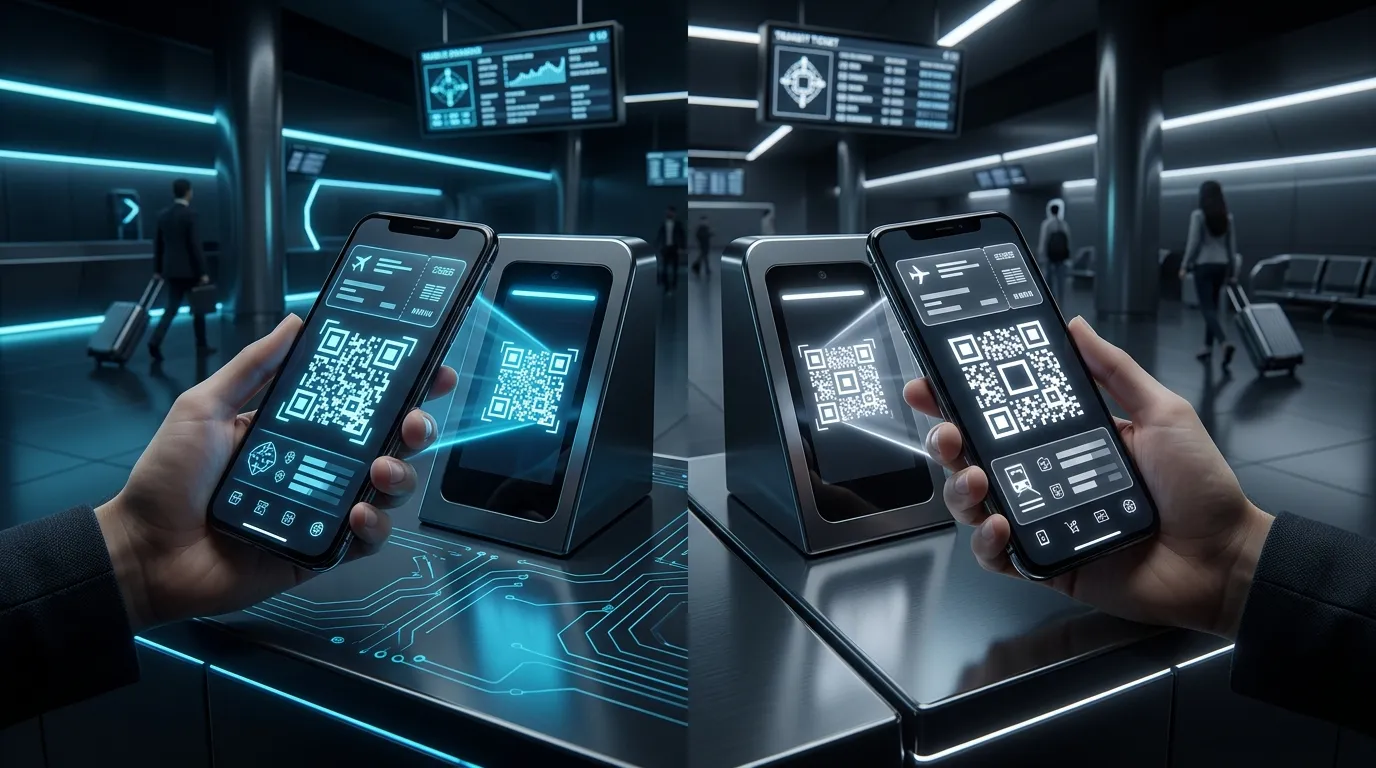
IATA's Bar Coded Boarding Pass (BCBP) standard explicitly supports Aztec Code, and most airlines' mobile boarding passes use it for exactly the quiet-zone reason above. The same property makes it popular for rail and event ticketing, where a barcode is often displayed full-screen on a phone with no guaranteed white border. Aztec Code is also royalty-free, which removed any licensing friction for large-scale transit adoption.
Aztec Code vs. QR Code
Both are square 2D matrix codes readable by any standard imaging scanner, but they differ in finder pattern, quiet-zone requirements, and typical capacity. If you're deciding between the two for a mobile ticketing or ID-card use case, our QR Code vs. Aztec Code comparison walks through the trade-offs in detail.